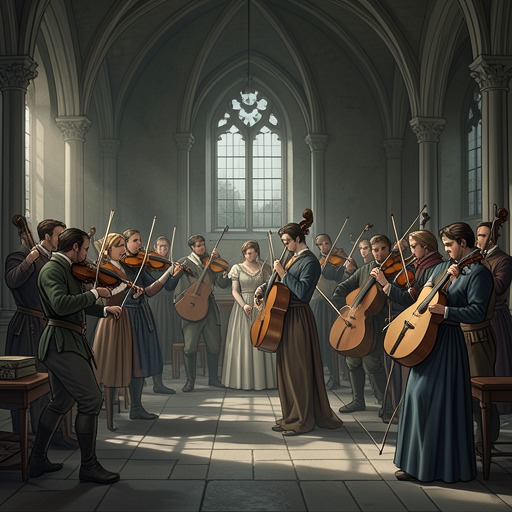
the church in Messina
Much Ado About NothingThe church in Messina is not merely a backdrop for religious observance. It is the public stage on which private affection becomes a social bond and on which that bond can be destroyed by public shame. Its meaning changes radically across the play: first a place of anticipated marriage, then the scene of Hero’s denunciation and apparent death, and finally the setting for mourning, recognition, and a second attempt to repair the community through ceremony.
Definition and Ceremonial Setting
The church appears as a formal, communal space rather than an intimate refuge. When the action moves there for the wedding, Don Pedro, Don John, Leonato, Friar Francis, Claudio, Benedick, Hero, Beatrice, and attendants are present together. The congregation makes the ceremony publicly witnessed, so that Hero’s identity and marital status are exposed to collective judgment rather than left to the private understanding of the lovers.
This public quality distinguishes the church from the more playful spaces associated with disguise, music, and festivity. Earlier, the revellers enter masked, and music organizes the social movement of the gathering; in the church, by contrast, ceremonial presence gives speech and accusation a heavier force. The same society that assembles for celebration becomes the audience before which honor is challenged and defended.
The Broken Wedding
The church’s first major dramatic function is to receive the wedding that should join Hero and Claudio. The ceremony begins under the authority of religious order, but it is interrupted when Claudio treats an allegation against Hero as proof of sexual betrayal. The sacred setting intensifies the violence of this reversal: the marriage rite, which ought to confirm identity and belonging, becomes an ordeal in which Hero is publicly rejected.
The consequences are immediate and severe. Hero is left for dead, and the princes are responsible for the belief that she has died. Friar Francis proposes that she be secretly kept in and that the household publish her death as fact. The church therefore becomes linked not only with the failed marriage but also with the extraordinary concealment that follows it. A living woman’s absence must be represented as death so that the community may feel the weight of the slander it has accepted.
Death, Mourning, and the Tomb
The church later returns as a place of explicit mourning. Leonato asks that the people of Messina be told how innocently his daughter died. His request shows that the crisis is not solved by private forgiveness alone: Hero’s reputation must be repaired before the same public world that witnessed her disgrace. The church supplies the appropriate setting for this transformation of a disputed accusation into a solemn account of innocence.
Claudio subsequently enters a church with Don Pedro and three or four companions carrying tapers. He asks whether the monument of Leonato is present, and the scene turns from wedding ceremony to memorial observance. He is instructed to honor the dead woman by hanging an inscription upon the tomb, praising her when he is silent, and having music sound a solemn hymn. The taper, monument, inscription, and hymn give physical form to remorse; grief is staged as a repeated public service rather than left as an unspoken inward feeling.
Ritual Repair and Recognition
The church’s final significance lies in its capacity to contain a second ceremonial beginning. Friar Francis’s intervention reframes the apparent death as part of a plan designed to expose the cost of credulity and restore Hero’s standing. The sequence moves through separation, mourning, and reintegration: Hero is withdrawn from ordinary social life, her death is proclaimed, Claudio is made to perform grief, and the community is prepared for a renewed recognition of her innocence.
This pattern gives the church a distinctive structural role. It holds incompatible states in succession without allowing either to disappear cheaply. Hero is first a bride, then publicly treated as dishonored, then declared dead, and finally made available for restored social recognition. The church thus becomes a threshold between identities, where the community’s judgment can condemn a person and where ritual can help undo that condemnation.
Narrative and Thematic Significance
The church concentrates the play’s opposition between appearance and truth. Outside it, disguise and masked festivity make misrecognition comic and mobile; inside it, misrecognition acquires legal, familial, and spiritual consequences. The failed wedding reveals how quickly a public ceremony can convert suspicion into social fact, while the funeral observances reveal how ceremony can also reverse that process by making innocence visible through collective mourning.
Its repeated use also creates a powerful contrast between music for celebration and music for penitence. Earlier music invites dancing and social pairing; at the monument, music becomes a solemn hymn. The church therefore marks a passage from playful courtship to the gravity of reputation, death, and restitution. By the end, it stands as the play’s most concentrated image of communal repair: a place where love is not simply declared, but tested before witnesses and restored through acts that publicly acknowledge what private feeling alone cannot mend.